
East Baton Rouge 72-Hour Releases
No rolling East Baton Rouge Parish 72-hour release feed was verified. The East Baton Rouge Parish Sheriff’s Office maintains a current inmate portal with an “In Custody On” control, but that control reports presence on a chosen date. It does not identify everyone who left during a three-day span. The portal also has no enabled release-date column or release-reason filter.
A three-day review remains useful as an evidence timeline. Search each relevant calendar date, record whether the person appears, and save the precise time of the check. A hit on Friday and no hit on Monday narrows when the person stopped appearing. It does not establish that the person went home. Parish Prison movement can lead to another parish, Louisiana DPS&C, federal or immigration custody, a hospital, forensic placement, or work release.
Review East Baton Rouge Releases
Build a short timeline rather than searching only once. The seven-day historical limit is long enough to review a recent three-day interval, yet short enough that a delayed check can lose useful online evidence. Start with the facility where the person was last known to be held.
- Open the official EBRSO inmate portal and search the full name with today’s setting.
- Repeat the search for each relevant “In Custody On” date. Record hits, no results, and the exact check time in Central Time.
- Call Inmate Records at 225-358-4000. Central Booking at 225-358-4009 is another 24-hour channel for a very recent movement.
- Ask for the recorded exit time, movement or release code, destination, and any remaining hold. Supply the booking number and date of birth when known.
- Check the court docket for an order, bond action, dismissal, sentence, time-served entry, probation, or later amendment.
- If the destination names another custodian, search that authority. Use DPS&C/VINELink, BOP Locator, ICE ODLS, or another local jail as the record indicates.
- Request the existing booking and release records through EBRSO when a written record is needed or online sources conflict.
The East Baton Rouge 24-Hour Releases path is more focused when the event occurred today. A three-day check is better suited to a missed day, a weekend interval, or an uncertain exit date. For one named person whose last custodian is unclear, use the East Baton Rouge Parish released-inmate search to trace local, state, federal, and court sources. Neither release-list page turns the current roster into a public release log.
East Baton Rouge Three-Day Fields
The useful fields come from two different kinds of records. Portal fields help identify the right person and document recent custody presence. Requested jail fields explain the actual exit. Keeping them separate prevents an arrest date or selected custody date from being mistaken for a release timestamp.
| Field | Use in a 72-hour review |
|---|---|
| Name and demographics | Compare possible roster matches without treating a name alone as proof of identity. |
| Mugshot | Supports identity while the result remains visible; it is not proof of present status or release. |
| Arrest date | Links the roster result to a booking episode, not to an exit. |
| In Custody On | Shows reported presence on the chosen day within the seven-day lookback. |
| Booking number | Connects phone, court, and records-request inquiries to the same custody event. |
| Release date and time | Supplies the event timestamp when obtained from the custodian. |
| Release code and destination | Distinguishes community release from transfer or another non-community exit. |
A court minute may explain the legal authority for movement, but it may not show the exact door-exit time or an unrelated hold. A VINE alert documents a categorized custody change subject to the alert’s wording and transmission lag. The agency release entry is closer to the physical event and may name the next custodian.
When a written timeline is needed, request records for the whole booking episode instead of asking for a list of “everyone released.” Give EBRSO a full name, date of birth or booking number, and the narrow three-day range. Ask for the booking sheet or jail card, release date and time, release or disposition code, public code definition, bond and charge data, and any destination or receiving agency. The EBRSO Administrative Services instructions route requesters to the official records process. Electronic copies may be requested. If material is withheld, ask for the legal basis and any part that can be released separately. East Baton Rouge published no verified flat release-record fee or fixed turnaround in the sources reviewed, so ask for an estimate before chargeable work.
Note: The portal’s seven-day online lookback does not establish how long EBRSO retains the underlying booking and release records.
East Baton Rouge Weekend Releases
A Friday-through-Monday comparison can preserve context that a single Monday search misses. Yet no official East Baton Rouge source found in the research states a special weekend release schedule, public family waiting process, or holiday posting timetable. Do not assign an exit to a weekend merely because that is when the name first disappears.
Processing can also separate a legal decision from physical release. A judge may authorize bond or release while the jail completes checks and clears holds. A parole grant can precede exit. A person leaving Baton Rouge City Jail may have posted bond, paid fines, or been transported to Parish Prison. Those events call for different records, even when each occurs within the same 72-hour span.
When offices reopen after a weekend or holiday, ask for the recorded event rather than a reconstruction from memory. Request the release date and time, the public release or disposition code, and the destination or receiving authority. If a code is unclear, ask for the agency’s existing public code key.
Keep each day’s evidence in order. The arrest date, selected custody date, court filing time, release time, and web-check time describe different events. A delayed court entry may appear after the person has moved, while a roster update may follow the jail’s internal entry. Marking the source beside each timestamp prevents a later posting from being mistaken for the physical exit.
East Baton Rouge Release Data
The local data arrangement is unusually easy to misread. CentralSquare offers seven days of historical “In Custody On” searching but no 24-hour or 72-hour release view. In parallel, the Louisiana Commission on Law Enforcement describes East Baton Rouge’s participating LA VINE roster as live current-custody data refreshed about every thirty minutes. That refresh claim belongs to the LA VINE roster layer, not to the sheriff’s separate portal.
These sources can show recent presence and a later custody-status change. They do not create a durable list of everyone released during the prior three days. Registration works best before the event, while the exact person’s record is available. If the person has already disappeared, the records request and court path become more important.
Spelling variants, suffixes, aliases, data corrections, and expungement can also affect a result. Compare stable identifiers and document conflicting records instead of merging them. A careful conclusion states which system was searched, the dates tested, and what that system did or did not report.
The official interface demonstrates the limited historical tool. View the East Baton Rouge Parish inmate portal source represented below.
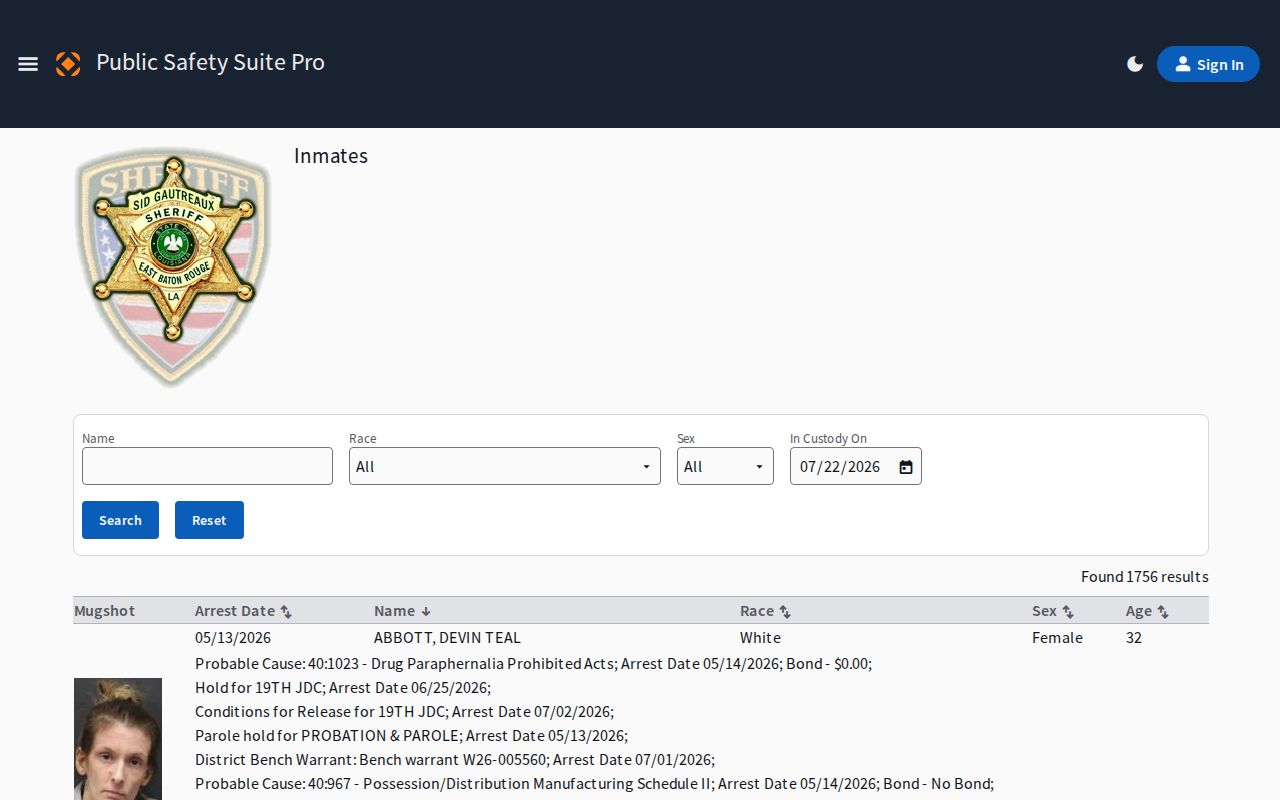
The “In Custody On” control supports a date-by-date presence timeline, not a released-person feed.
Confirm East Baton Rouge Exits
The fallback depends on the custody class. For Parish Prison, start with EBRSO Inmate Records and the sheriff’s public-records route. For City Jail, use the City Jail booking or bonding office and Baton Rouge City Court, then check Parish Prison if transport was possible. Juvenile records are confidential and do not belong in an adult release workflow.
The Transitional Work Program needs its own caution. It is a custody placement for eligible state-sentenced people nearing release, even when a participant works or joins activities outside the secure complex. A move into that program during the 72-hour interval is not a community discharge. Confirm the later exit with the program and DPS&C, then determine whether Probation and Parole has an active case. Likewise, a City Jail departure may mean transfer to Parish Prison rather than release. City Jail records, the City Court docket, and a Parish Prison search can document those linked steps.
- Community release
- Look for a jail release entry plus the court act, bond event, sentence completion, or other legal basis.
- State custody
- Use Louisiana VINELink and DPS&C. A possible release date is not proof that a person left.
- Federal custody
- Use BOP Locator for sentenced federal cases. A federal pretrial detainee may instead require the court docket and USMS or host-jail records.
- Immigration custody
- Use ICE ODLS when the destination indicates ICE. A local jail exit under a detainer may begin federal immigration custody.
Still-in-custody and released searches answer different questions. A current roster result reports the sending agency’s present status. A prior-day hit reports historical presence. The release entry reports the exit, while the receiving system can confirm a transfer. A responsible no-result statement names the system and check time without concluding that the person is free.