
East Baton Rouge Release Milestones
A date can describe sentence expiration, a possible good-time release, parole eligibility, a Board grant, or actual release. Those milestones are not interchangeable. Louisiana DPS&C uses “possible release date” for the information available through its public phone line. Research did not verify a universal projected-date field or a permanent discharged-person result in VINELink. Copy the agency’s exact words instead of relabeling the answer.
A pretrial detainee usually has no computed sentence-release date. The next event may depend on bond, a hearing, dismissal, diversion, or trial. A person serving a parish or state sentence may have a computed date, but the custodian must apply the sentence and credit rules. If another agency has a hold, reaching one date may cause a transfer rather than community release.
- Possible release date
- The current official estimate after sentence and credit rules are applied.
- Parole eligibility
- The earliest point at which the Board may consider an eligible case.
- Parole grant
- An approval that may still require a date, processing, plans, and clearance of holds.
- Actual release
- The recorded departure from that custodian, including any destination or receiving agency.
Find East Baton Rouge Release Dates
Start with legal custody, not the place of arrest. East Baton Rouge Parish Prison may hold a local detainee, a newly sentenced person awaiting a DPS&C bed, or someone held for another authority. The commitment and booking record help identify who computes the date. Use full identity data and the booking or DOC number to avoid merging people with similar names.
- Determine whether the person is pretrial, serving a parish sentence, or in DPS&C custody. Check the court minute or commitment when that is unclear.
- For state custody, find the exact person through Louisiana VINELink. Note the displayed status and facility, but do not promise a visible date field.
- Call the DPS&C possible-release-date line at 225-383-4580 with the DOC number. Ask whether the answer is good-time release, full term, parole eligibility, or another milestone.
- For a parish sentence, call East Baton Rouge Parish Prison Inmate Records at 225-358-4000. The sheriff has authority over qualifying parish good time under the older legal regime.
- Read the sentencing court record for the imposed term, jail credit, amendments, split sentence, or probation. Serious cases belong to the 19th JDC path; municipal and most misdemeanor City Court matters use the city tribunal.
- Recheck custody after the forecast and request the recorded release date, type, and destination when written proof is needed.
If the last custodian is uncertain, use the full East Baton Rouge Parish released-inmate search path before relying on a date.
Louisiana Good-Time Date Rules
For eligible felony offenses committed on or after August 1, 2024, R.S. 15:571.3.1 permits diminution for good behavior of up to fifteen percent of the imposed sentence. Diminution means a lawful reduction in time served based on statutory credit. The words “eligible” and “up to” matter. Sex-offense convictions as defined by the cited law and Habitual Offender Law sentences are excluded, and other provisions affect additional credit, split sentences, and forfeiture.
The common eighty-five-percent statement is arithmetic, not a universal release promise. If an eligible person earns the full fifteen-percent reduction, the corresponding point is eighty-five percent of the imposed term. DPS&C must still apply the individual facts. An abstract ten-year eligible post-2024 term has a statutory maximum good-time reduction of fifteen percent, but that statement is not an individual calculation.
The official statute screen documents the current ceiling.
Review Louisiana’s current good-time provision with the offense date and sentence in hand.
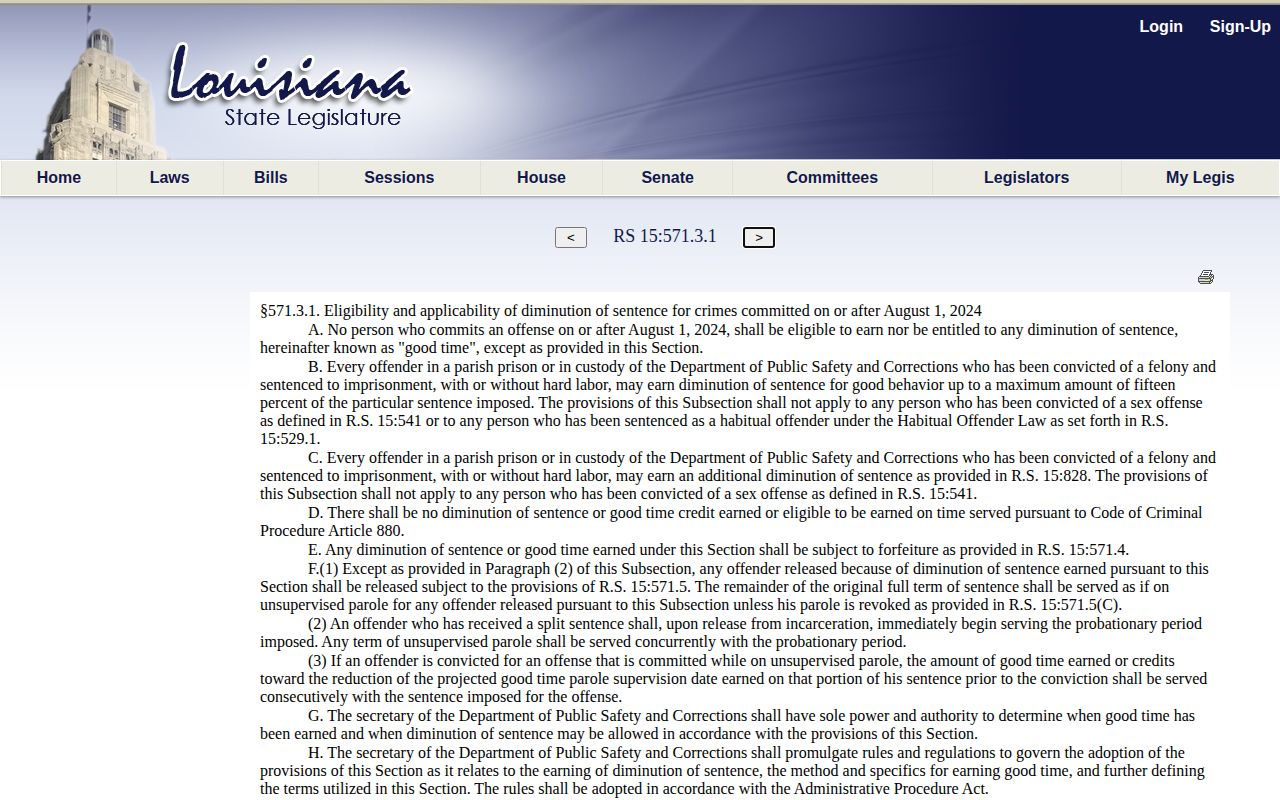
The captured law supports the maximum-credit rule, but the custodian remains responsible for the person-specific computation.
Why East Baton Rouge Dates Change
A possible date is recalculated when the legal or factual inputs change. Some changes move it later. Others may move it earlier. A hold can leave the sentence date intact yet prevent release to the community. Record the date and source of each answer so two different computations are not mistaken for one contradiction.
| Factor | Possible effect | Source to check |
|---|---|---|
| Good-time forfeiture | May move the possible date later | DPS&C or sheriff computation under R.S. 15:571.4 |
| Jail-credit correction | May move the date in either direction | Court order, commitment, and custodian |
| Consecutive terms | Can extend the total time | Sentencing minutes and computation record |
| Program or added credit | May reduce time when authorized | DPS&C calculation under the governing statute |
| Detainer or other hold | May cause continued or transferred custody | Sending and receiving agencies |
| Parole action | Changes eligibility or release processing, not necessarily the sentence end | Board docket, result, and facility status |
Note: Reaching one sentence milestone does not prove community release when another case, detainer, or receiving authority remains active.
Confirm East Baton Rouge Release
Register on the corroborated VINE inmate record before the expected event when the notification control is available. Louisiana’s local program supports custody-change alerts, but a sending-agency change can reflect transfer. After an alert, call the jail or DPS&C and ask whether the person entered the community or went to another authority.
For East Baton Rouge Parish Prison, request the booking and release entry with the recorded date and time, release or disposition code, and destination or receiving agency. For state custody, ask DPS&C for an existing releasable actual-release record. A court minute may explain the legal basis, but it may not show the precise time staff completed release.
When the sources disagree, retain both timestamps. A court can authorize release before jail processing ends. A Board grant may precede the physical exit. VINELink can lag the source record. The narrow safe statement identifies which system reported which status and when.
Older Louisiana Release Calculations
Offenses before August 1, 2024 remain subject to the older structure in R.S. 15:571.3. Eligible parish prisoners sentenced without hard labor can have a thirty-for-thirty credit structure. A first crime of violence uses a much lower three-for-seventeen rate. Eligible DPS&C felony cases can use a thirteen-for-seven structure, with exclusions and alternate treatments stated in the law.
Those ratios are not safe public calculators. The governing version, offense class, prior record, sentence type, multiple counts, discipline, and jail credit all matter. The newer fifteen-percent ceiling cannot be applied retroactively merely because a person’s release may occur after 2024. Ask which statute and offense date the custodian used.
Authority also differs. Under the older regime, the sheriff determines qualifying parish credit under law and regulations. DPS&C handles department cases and the new provision. The commitment identifies the legal custodian, so it is a better starting point than the building where the person is temporarily housed.
East Baton Rouge Date Records
A useful records request asks for an existing entry rather than a new date calculation. For Parish Prison, identify the person and booking episode, then request the booking and release record with release date and time, release or disposition code, destination or receiving agency, charges, and bond data. Ask for any public code key the jail already maintains. Do not guess what an unexplained abbreviation means.
The live EBRSO portal does not supply that release field. Its “In Custody On” control reaches back only seven days and shows historical presence, not the later manner of exit. Underlying retention may be longer, but no authoritative local retention period was found. Ask Inmate Records or the public-records custodian. The seven-day online limit is not a destruction schedule.
For DPS&C, request a specifically identified releasable actual-release record after the possible date. Public disclosure of inmate records is limited, so a full sentence-computation file may be withheld or redacted. The department’s public-records email is not the channel for a general computation question. Use the possible-date phone line for that question and the records process for an existing document.
Time labels deserve precision. Record whether the date is arrest, booking, custody-on, eligibility, possible release, court filing, actual release, or supervision discharge. Also note the time of the check. A midnight update or delayed transmission can make two official systems differ without either record describing the same event.
Parole Is a Separate Date
Parole eligibility is not a projected release date. For offenses on or after August 1, 2024, R.S. 15:574.22 generally bars parole except for listed categories. Earlier cases may fall within percentage categories and exceptions in R.S. 15:574.4. Only a review of the correct law and record can show eligibility.
The Committee on Parole may grant, deny, defer, or withdraw a matter. Eligibility means the case can be considered. A grant is an approval subject to the applicable date, processing, release plan, and unresolved holds. Actual release is the later custodial event. Keep those three facts separate when recording a timeline.
A person leaving on diminution can also face supervised or unsupervised parole consequences without the ordinary Board-grant path. A split sentence starts probation as provided by the court. The assigned district can confirm supervision only after the correct release path and identity are established.