
East Baton Rouge VINE Coverage
Louisiana calls its service LA VINE, or the Louisiana Victims Notification Network. East Baton Rouge appears on the state’s participating-parish roster list. The local layer receives current custody information from the parish jail system, while Louisiana DPS&C also routes its public “Locate Imprisoned Person” link to VINELink. The official person search begins at Louisiana VINELink.
Coverage does not make VINE a permanent released-person archive. The East Baton Rouge local roster is a current-custody product. The LCLE LA VINE overview describes the statewide service, and LCLE says participating-jail data is live and refreshed about every thirty minutes. The research did not use a real named person to force a released sample, so no universal release label or retained release-date field was verified. VINE can report custody information and status changes, but copy should not promise that every released person stays searchable.
Custody class controls the next step. Parish jail records belong first to EBRSO or City Jail. State-prison records belong to DPS&C. BOP Locator covers sentenced federal custody, and ICE ODLS covers its own system. A federal pretrial detainee housed in a parish jail may need both the jail movement record and the federal docket.
Search East Baton Rouge VINE
Use the fullest reliable identity data available. A name match is only a candidate match. Age or date of birth, booking or offender number, reporting facility, arrest timing, and the related court case help separate people who share a name.
- Open the Louisiana person-search screen and confirm that Louisiana is selected.
- Enter the full name. Add a known booking or offender identifier when the live form offers that field.
- Review all possible matches. Compare age or date of birth and the reporting facility or agency.
- Open only the record supported by more than a name. Do not merge details from two similar results.
- Read the custody status and facility wording exactly as displayed. Note the date and time of the check.
- If the record shows a movement or later disappears, contact the sending agency and search any likely receiving authority.
The official screen below shows the source used for a Louisiana-specific person check. Open the live LA VINE search because controls and displayed terms can change.
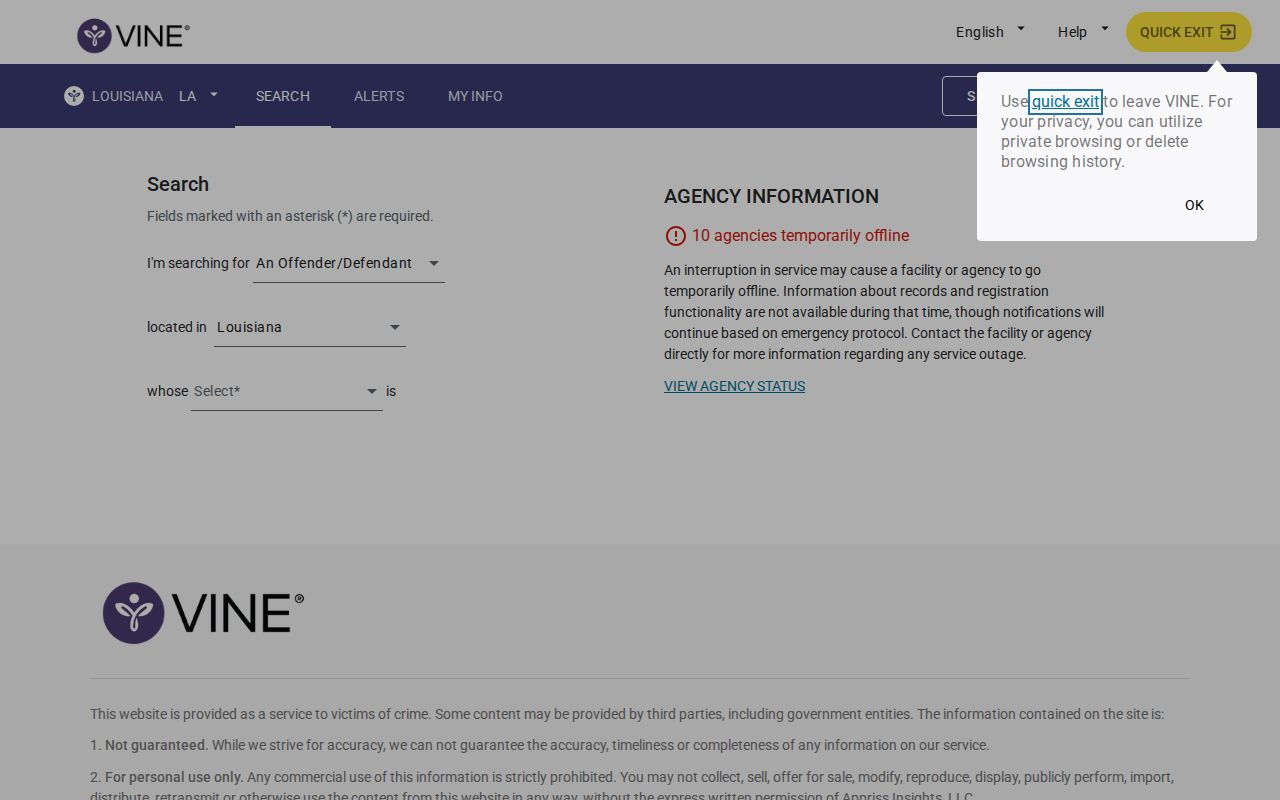
The search screen begins the match. The agency record and court history supply context that a custody-status line cannot provide by itself.
Note: Record a narrow no-result: no matching current record appeared in the named system at the time checked.
East Baton Rouge VINE Fields
Read only fields visible on the live matching record. Louisiana materials support custody status, reporting facility or agency, identity details, and a registration link. They do not support a promise that all profiles show a lasting actual release date or use a fixed “Discharged” label.
| Field | How to use it |
|---|---|
| Name | Starts the match but must be checked against other identifiers. |
| Date of birth, age, gender, or race | Compare only the identity details that the live record supplies. |
| Booking or offender identifier | Helps distinguish the right custody episode and supports an agency follow-up. |
| Reporting facility or agency | Identifies the custodian responsible for confirming a release or transfer. |
| Custody status | Reports the category received by VINE at the check time, subject to data lag. |
| Notification control | Registers contact information for later custody-change notice while available. |
A future date, when any source shows one, is not confirmation that release occurred. DPS&C’s verified public term is “possible release date,” available through its separate phone channel. Sentence calculations, court changes, detainers, disciplinary forfeiture, and parole decisions may change that date. Recheck status after the event and obtain the actual record.
Register East Baton Rouge Alerts
Register on the exact matching person record before the change. LCLE expressly supports phone and email registration. Text or TTY availability should be accepted only when the live interface offers it. The notification form controls the confirmation steps and should be followed as displayed.
- Select the notification or registration option on the corroborated person record.
- Choose among the channels currently offered. Enter the correct phone number or email address.
- Complete the confirmation shown by the interface. Review the event types connected to that registration.
- If the telephone flow requests a PIN, create and retain it. The research did not verify a universal PIN length.
- When an automated call requests acknowledgment, enter the PIN as instructed so repeated calls can stop.
- Keep the registration active until the event. Update contact information through the service when needed.
- After an alert, call or request the reporting agency’s record to identify release, transfer, or another change.
A registration is person-specific and system-specific. If the person leaves Parish Prison for another custodian, the local alert may describe a change from the sending system. It does not by itself prove unrestricted community return. Preserve the alert wording and time, then follow the destination.
Registration also works best before the expected change. Once a person drops from the current local record, the notification control may no longer be available, and no durable released profile is promised. In that situation, shift to EBRSO Inmate Records, the court case, and a targeted release-record request. Ask for the existing entry rather than asking staff to form a conclusion. Useful fields include the booking and release times, movement code, destination, and receiving agency. A VINE notice can then be compared with that entry instead of being made to carry more proof than the system provides.
East Baton Rouge Notice Layers
Louisiana has a distinctive two-layer notice structure. Local LA VINE registration provides custody updates tied to a participating jail record. DPS&C states that local LAVNS registration is not the same as its Victim Outreach registration for projected and actual state-prison release notices. The correct route therefore changes when someone moves from parish custody into a state institution.
Eligible participants seeking formal state-prison notice should use DPS&C Victim Services, which lists 225-342-1056 and 1-888-342-6110. Board hearing notice is another distinct process. Do not assume a local jail alert automatically enrolls a contact for state release projections, actual DPS&C release, or a parole hearing.
The official Victim Services source below illustrates the state layer reviewed for East Baton Rouge Parish.
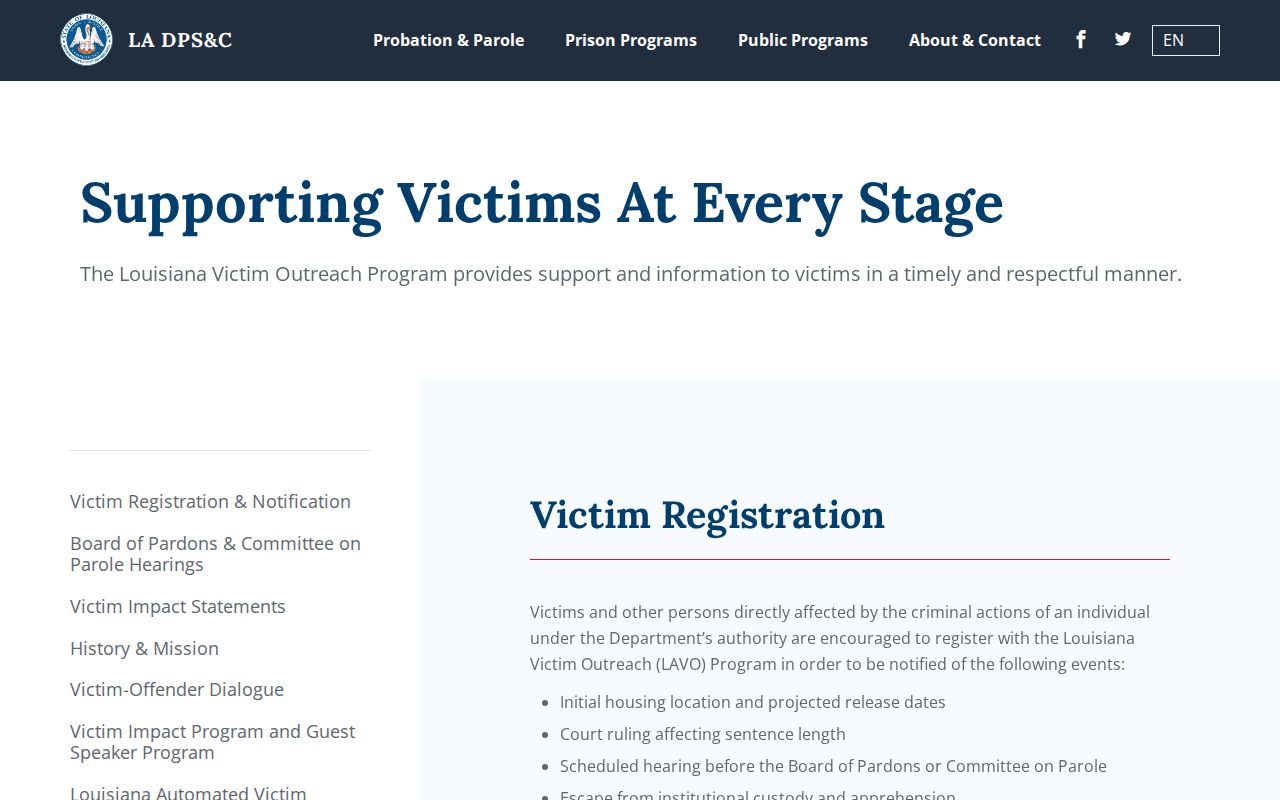
This distinction keeps local custody alerts and formal state-prison outreach from being treated as interchangeable services.
Confirm East Baton Rouge Releases
An alert should trigger verification, not end it. For East Baton Rouge Parish Prison, call Inmate Records at 225-358-4000 or Central Booking at 225-358-4009 and ask for the recorded event and destination. If written proof is needed, request the booking and release entries, including date and time, release or disposition code, and receiving agency. The relevant court docket can explain the order or disposition behind the move.
- Release
- An exit from one custodian. It may be to the community or another authority.
- Transfer
- A movement into another jail, state facility, federal custody, ICE, hospital, or forensic placement.
- Discharge
- An end to the custodial or correctional status described by that record, which must be read in context.
- Detainer
- A request or hold connected to another authority that may block or redirect community release.
The complete named-person path is available through the East Baton Rouge Parish release search. Use EBRSO and the court for a parish detainee, Louisiana DPS&C and VINELink for a state prisoner, BOP Locator for a sentenced federal prisoner, and ICE ODLS when immigration custody is indicated.
East Baton Rouge VINE Limits
VINE data can lag. Transfers can look like release from the sending agency. Same-name matches occur, and an expunged, sealed, juvenile, or otherwise confidential record may not be public. A missing result can also stem from spelling, suffix, alias, agency, or data-entry differences. None of those possibilities supports a broad conclusion about freedom or custody.
Registry information is also separate. Louisiana’s sex-offender registry applies only to people with a qualifying registration duty and is not a universal released-inmate database. A registry entry cannot supply the jail release date or reason, and most released people will not appear there. No official separate statewide violent-offender or arson-offender registry was verified in the research. Keep a VINE custody check focused on the matching custody record and use the jail, department, or court for the underlying event.
VINE does not replace BOP Locator, ICE ODLS, a federal docket, or the correct local court disposition. Nor does the current East Baton Rouge roster preserve a certified release archive. The strongest result joins the alert with the release entry, court act, or receiving-agency match.
Federal results require their own reading. BOP Locator covers sentenced federal prisoners from 1982 forward and can show a past release date with no facility, but it does not cover an ordinary parish arrest or all federal pretrial custody. ICE ODLS uses an A-number and country of birth, or exact biographical fields, and retains some release-from-ICE records for a limited period. A Parish Prison exit under an ICE detainer may be the start of immigration custody. Search the destination named by EBRSO rather than expecting the Louisiana VINE record to report the entire federal chain.
Timing also affects what two systems show. Louisiana agencies record local events in Central Time, while a person checking from elsewhere may read a different local date. A midnight update or delayed transmission can make an accurate jail entry and an accurate VINE status appear inconsistent for a short period. Save the alert text, the reporting agency, and both timestamps. When the sequence is unclear, ask the source agency which event generated the change and whether another hold or destination remained. That focused question is more reliable than treating the newest screen as a correction of every earlier record.