
East Baton Rouge Supervision Types
Parole and probation both allow a person to live outside a jail or prison under stated rules, but they begin in different records. Parole is a conditional release from incarceration while the sentence remains in effect. The Louisiana Board of Pardons and Committee on Parole makes parole decisions in eligible cases. Probation is imposed by a judge. It can be the main sentence or can start after the custody part of a split sentence. Louisiana DPS&C Probation and Parole supervises both types in the community.
A third path matters in East Baton Rouge Parish. A person who earns diminution, commonly called good time, may leave custody with supervised or unsupervised parole consequences set by the law tied to the offense date. That exit is not necessarily a Board grant. Full-term discharge is different again because the sentence has ended. Read the court minute, Board result, or DPS&C release record before assigning a label.
| Record type | Who starts it | Best verification |
|---|---|---|
| Parole | Committee on Parole grant or a statutory release consequence | Board result, DPS&C status, then assigned district |
| Probation | Sentencing court | Court minute and assigned Probation and Parole district |
| Full discharge | Sentence completion recorded by the custodian | DPS&C or parish release record and discharge confirmation |
- Parole
- Conditional release from incarceration before the sentence fully ends.
- Probation
- Court-ordered community supervision, sometimes following a split sentence.
- Discharge
- The official end of custody or supervision shown by the responsible agency.
- Absconder
- A person authorities allege has stopped reporting or otherwise left supervision without approval.
Verify East Baton Rouge Supervision
Louisiana provides no verified public name-by-name parolee search separate from VINELink. Verification therefore requires a short chain of official checks. Use the full name, date of birth, DOC number, court case number, and last facility when available. A current jail roster only reports custody. It does not establish parole, probation, or discharge after release.
- Identify the legal path. Read the sentencing court minute for probation, the Committee on Parole result for a Board case, or the release record for good-time or full-term discharge.
- Check the exact person in Louisiana VINELink. Record the status, reporting facility, and check time, but do not treat a missing result as proof that supervision ended.
- Review the Board dockets and results archive when parole was considered. An agenda shows scheduling; minutes or results show the recorded outcome.
- Call the correct DPS&C district with identity details and the DOC number. Ask whether that district or another district holds the case.
- Request the discharge or case record from the supervising agency when a final written answer is needed.
The broader custody and court chain is described in the East Baton Rouge Parish released-inmate search. Use it when the last custodian or release type is not yet known.
East Baton Rouge Supervision Office
The Baton Rouge Probation and Parole District covers most of East Baton Rouge Parish. Its official coverage description has important exclusions, so the nearest office is not always the assigned office. Ask which district and unit has the DOC number. Privacy and records limits may restrict what staff can disclose, but a routing check prevents a false no-record conclusion.
Baton Rouge Probation and Parole District
2751 Wooddale Boulevard, Suite 400
Baton Rouge, LA 70805
225-922-0227
Monday through Friday, 8:00 a.m. to 4:30 p.m.
The official district screen helps confirm the office and its stated territory.
View the DPS&C Baton Rouge district source before calling, especially if the person lives near a coverage boundary.
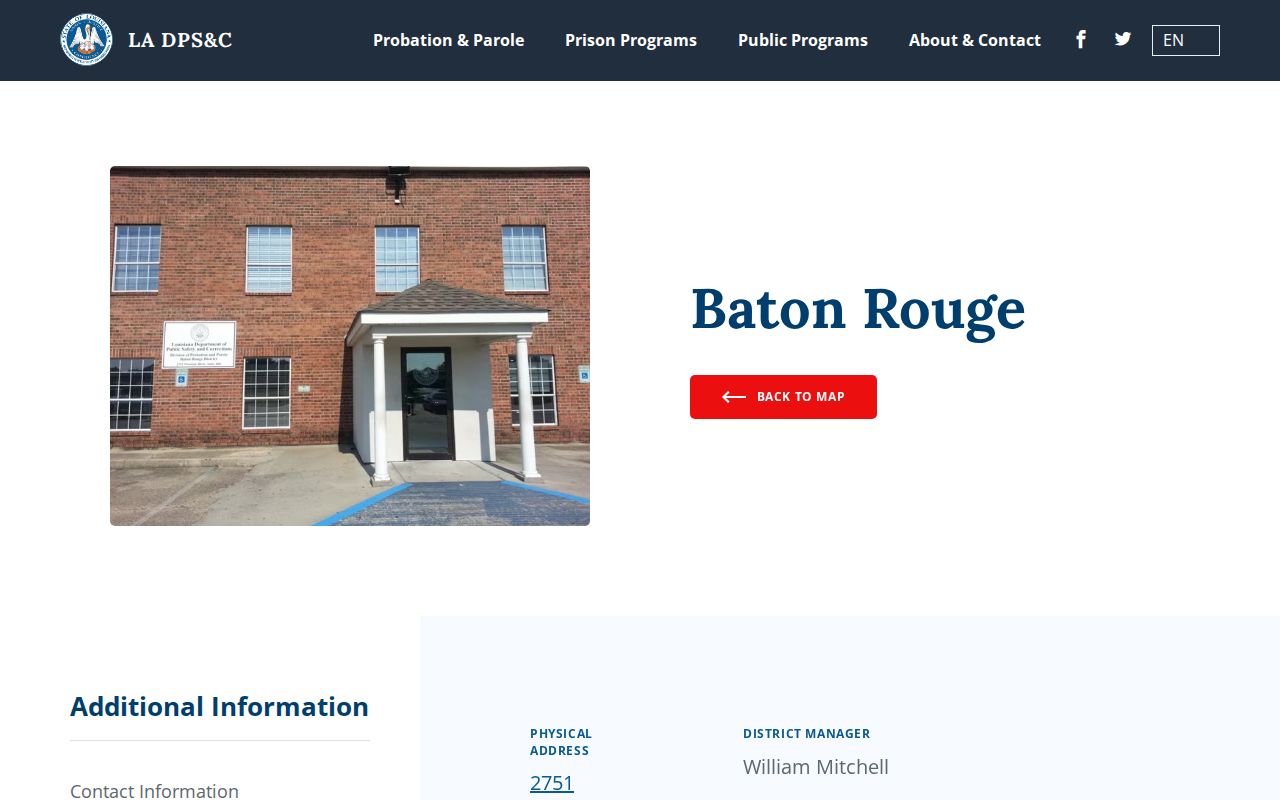
The captured source shows why an office-based check is stronger than a guess based on a Baton Rouge mailing address.
East Baton Rouge Supervision Status
Conditions are the rules attached to a parole or probation case. Their exact terms come from the court, Board action, certificate, and supervising officer, not from a general roster. A violation is an alleged failure to follow those rules. It may lead to instructions, a hearing, a warrant, or custody, depending on the case. An absconder label means supervision officials allege the person stopped reporting or left oversight without approval. It is not a new conviction.
The Baton Rouge district describes specialized units and work with local authorities and the U.S. Marshals Service. Still, no official public East Baton Rouge Parish list was verified as a complete supervision or absconder lookup. A sheriff warrant search cannot be substituted for direct DPS&C confirmation. If a person returns to custody, VINELink can report a custody change, but it does not explain every supervision decision.
Use narrow language when results conflict. A Board grant proves a decision. A district confirmation proves a supervision case. A warrant record proves an active allegation or order at the time checked. None alone proves that the person physically left a facility on a certain day.
East Baton Rouge Supervision Discharge
Supervision ends through an official discharge, expiration, court action, or another case-specific event recorded by the responsible authority. A person moving, changing officers, or disappearing from a public custody result has not necessarily been discharged. Obtain the final record from DPS&C for parole supervision or from the sentencing court and supervision office for probation.
Offense date also shapes the path. R.S. 15:574.22 generally makes people committed for offenses on or after August 1, 2024 ineligible for parole, subject to stated exceptions. Earlier eligible cases can fall under R.S. 15:574.4 and its detailed categories. Those laws address eligibility, not proof of release or final discharge.
For Board cases, the official archive distinguishes granted, denied, deferred, and withdrawn outcomes. A deferred matter is not a denial. Even a grant can precede the actual exit while processing, a release plan, or a detainer remains unresolved. Confirm physical release, then confirm the assigned supervision case, and later seek a discharge record.
East Baton Rouge Parole Decisions
The Louisiana Board of Pardons and Committee on Parole publishes process guidance, annual schedules, dockets, and results. Hearings are generally held by Zoom and streamed through the Board’s official channel, subject to its attendance and participation rules. The Board says hearings are usually scheduled within nine months of eligibility. Always use the current annual schedule because a prior calendar cannot establish a new hearing date.
An agenda proves that a matter is set. It does not prove the result. The results or minutes can show granted, denied, deferred, or withdrawn, sometimes with votes or conditions. Copy that exact term. R.S. 15:574.2 requires records of Committee acts and institutional notice of decisions, among other procedures.
The official Board page illustrates the source path for decisions and later supervision checks.
Review the Louisiana parole process source before interpreting a docket entry.
The captured page separates the Board decision process from the later facility exit and district supervision record.
Which East Baton Rouge District?
Supervision geography is split in a way that can surprise callers. Baker, Zachary, Greenwell Springs, Pride, Slaughter, Central, and portions of Baton Rouge are excluded from the Baton Rouge district’s own coverage description. Some East Baton Rouge Parish territory is assigned through the West Baton Rouge District.
West Baton Rouge District
1120 Northwest Drive
Port Allen, LA
225-342-2770
Monday through Friday, 8:00 a.m. to 4:30 p.m.
A “no case here” response should start a district-routing check. It should not become a claim that parole or probation ended. Give the DOC number and full identity, ask whether another district owns the file, and document the office and time contacted.
Note: District assignment can differ from the city in a postal address, so verify routing before interpreting a no-record response.
Work Release Is Still Custody
The East Baton Rouge Parish Transitional Work Program is a custody placement for eligible state-sentenced people nearing release. A participant may work or take part in activity outside the secure setting while remaining legally confined. Presence in the LAWF program is therefore not proof of community release or parole.
Confirm the later exit with the program or DPS&C, then contact the assigned Probation and Parole district if supervision follows. The release may begin parole, probation after a split sentence, an unsupervised-parole balance under the governing good-time law, or no supervision after full-term completion. Only the case record can identify which path applies.
City Jail Property After Release
Baton Rouge City Jail records and safeguards incoming personal property, photographs, and fingerprints. People leave that short-term facility by posting bond, paying fines, or transferring to East Baton Rouge Parish Prison. A City Jail exit can therefore be a move to another custodian rather than the start of supervision.
Property and movement questions belong first to City Jail. Its booking desk is 225-389-8433, and its bonding office is 225-389-8380. No official public property-pickup procedure after release was verified, so callers should ask the jail for current instructions instead of relying on an assumed process. Once the movement is clear, use the court minute and correct DPS&C district to determine whether probation, parole, or no supervision followed.